Zi Wei Dou Shu Chart Example Image: The 12 Palaces Explained
Most explanations of Zi Wei Dou Shu stay abstract. This page does the opposite: it shows an actual chart example image and walks through how to read it, piece by piece. When you can recognize the parts of one chart, every other chart starts to make sense.
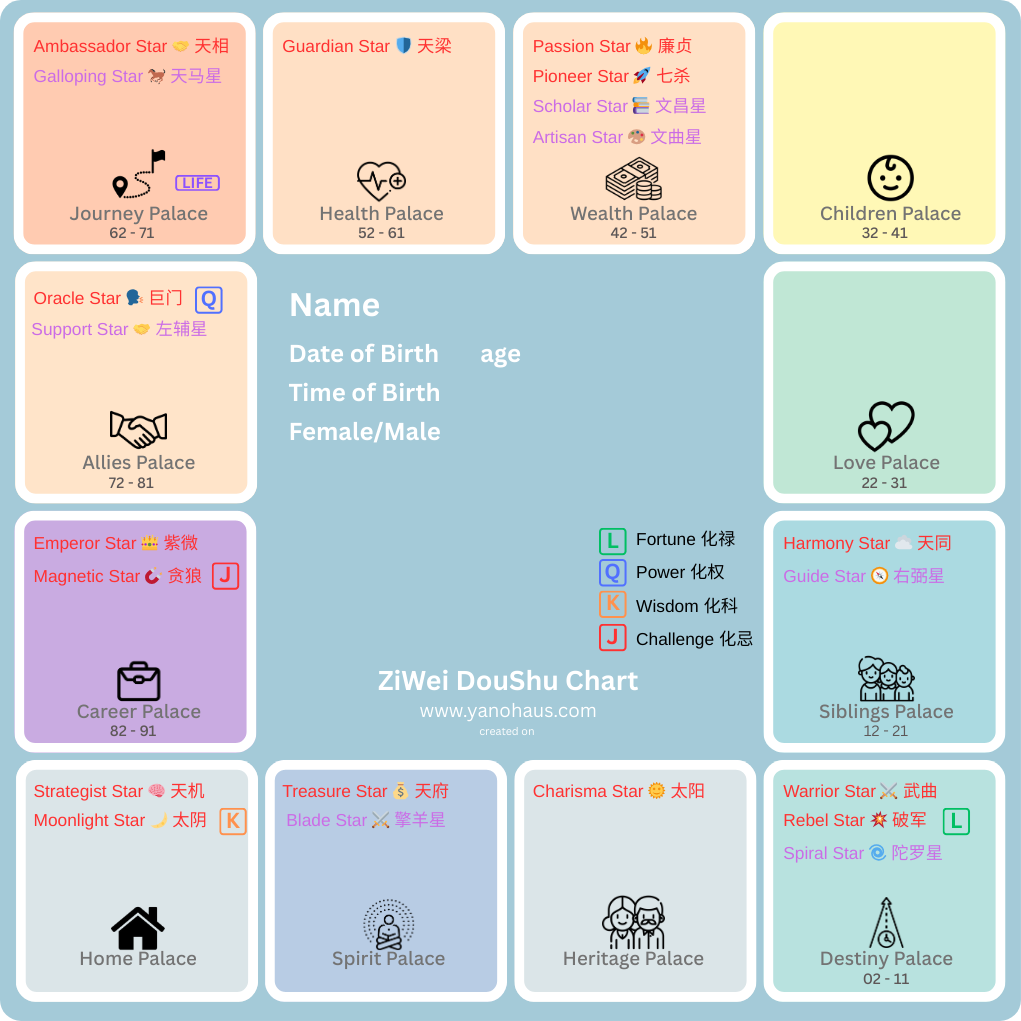
An example Zi Wei Dou Shu chart: 12 palaces around the edge, birth data in the center. This is the same chart used in our sample reading.
How the Chart Is Laid Out
A Zi Wei Dou Shu chart is a square grid of 12 boxes arranged around a center panel. Each box is a palace (宫), one area of life: self, siblings, relationships, children, wealth, health, travel, friends, career, property, mindset, and parents. The center panel holds the birth data the chart was calculated from: date, time, and gender.
Unlike a Western horoscope wheel, nothing here is drawn from planet positions in the sky at a glance. The grid is calculated from the lunar calendar version of your birth date and your birth hour. That is why an accurate birth time matters so much: shift the hour, and the stars land in different palaces.
Where to Find Four Key Palaces in This Example
Once you know the grid is 12 boxes around a center panel, the next step is finding specific palaces. In the chart image above:
- Destiny Palace, bottom right box: your core character and how you move through life.
- Career Palace, left middle box: your work style and how you approach ambition.
- Wealth Palace, top row: how you handle money, risk, and security.
- Love Palace, right middle box: how you open up and connect with a partner.
These positions apply to this specific example chart only. Palace placement shifts with your own birth date, time, and gender, so your Destiny Palace, Career Palace, Wealth Palace, and Love Palace will very likely sit in different boxes than they do here. Treat this image as one worked example, not a universal map.
Reading One Palace in the Example
Every reading starts at the Destiny Palace (命宫), the box that describes your core character and how you move through life. In this example chart, the Destiny Palace holds the Warrior Star (武曲) and the Rebel Star (破军), accompanied by Fortune Flow (化禄) and the Spiral Star (陀罗).
Read together, that combination describes someone who looks calm and steady on the outside but wants to break old patterns and build new systems: slow to commit, fast and forceful once committed. You can see how this one palace unfolds into several paragraphs of plain-language interpretation in the full sample reading.
What Each Part of the Chart Example Means
- Palace names: the label in each box telling you which life area it governs.
- Major stars: the 14 principal stars (like 紫微, 武曲, 天相) that set the main theme of a palace.
- Transformations: the four annual modifiers (化禄, 化权, 化科, 化忌) that show where energy flows or gets stuck.
- Decade cycles (大限): the ten-year periods that time when a palace's themes become active.
If you want the full map of what all 12 palaces cover, the chart interpretation guide walks through each one.
From Example to Your Own Chart
An example can show you the structure, but the interesting part is seeing your own stars. The YanoHaus preview generates your chart from your birth date and time, then gives you the first sections of a written interpretation for free, the same format as the sample reading above.
Common Questions
What do I need to generate a chart like this example?
Your birth date, birth time (as precise as possible), and gender. The chart is calculated from these three inputs.
Why does the chart use Chinese characters?
The star and palace names come from the classical system. YanoHaus readings translate every star into a plain-English name (武曲 becomes the Warrior Star, 天相 the Ambassador Star) so you never need to read Chinese to understand your chart.
Is every chart unique?
Charts repeat in structure, but the combination of palaces, stars, transformations, and timing cycles makes each reading personal. Two people with the same Destiny Palace star can still have very different charts.
Want to see your own chart?
Start with the free YanoHaus preview. Enter your birth details and read the first sections of your own Zi Wei Dou Shu chart at no cost.
Not sure yet? Read a sample reading first.